
When business owners start shopping for home care CRM software, they almost always land on the same two names: HubSpot and Salesforce. Both are well-known, widely marketed, and come with impressive feature lists. On the surface, the pricing looks manageable — a few hundred dollars a month, a one-time setup fee, and you’re off and running.
What the pricing pages don’t show you is everything that comes after. The configuration hours. The custom builds. The workarounds. The support calls that go nowhere because the rep on the other end has never heard of a referral partner or a caregiver pipeline.
Most CRMs are built for B2B sales teams, not for the operational complexity of running a home care agency — and by the time you’ve configured a generic platform to approximate what purpose-built home care software offers on day one, the real cost looks nothing like the advertised price. Many CRM solutions also come with additional costs beyond the base price, so it’s important to understand exactly what’s included before you commit.
Home Care Agency Management
Managing a home care agency is a balancing act that requires seamless coordination across multiple fronts — caregiver scheduling, client visits, referral partner relationships, compliance requirements, and care delivery. This complexity means the right CRM for home care isn’t a luxury; it’s the operational foundation your business runs on.
A robust customer relationship management platform is essential for tracking referrals, monitoring lead sources, and capturing every client interaction. By centralizing these functions in the same system, agencies can eliminate paper documents, streamline workflows, and give leadership the actionable insights they need to effectively manage financial performance and support agency growth.
The Hidden Costs of HubSpot and Salesforce for Home Care Agencies
Neither HubSpot nor Salesforce includes onboarding in their base pricing. HubSpot’s onboarding fees start at $3,000. Salesforce implementation costs typically range from $5,000 to $25,000 or more depending on complexity. Those fees get you a configured CRM platform — not purpose-built home care agency software.
What you receive is a general-purpose sales and marketing tool set up to loosely mirror your workflows. In contrast, the best home care software solutions are designed specifically for the industry, offering features tailored to agency needs and streamlining essential management tasks from day one.
From there, the additional costs continue to accumulate. Custom fields need to be built for home care-specific data. Separate pipelines need to be created for client intake and caregiver management. Referral source tracking needs its own structure. Integrations require third-party automation tools or developer work. Because neither platform was designed for senior care operations, every configuration has to be built from scratch — and rebuilt any time your process changes.
For a home care business owner already managing patient care coordination and caregiver scheduling simultaneously, that financial commitment to an unproven setup carries real risk. For most homecare agencies in the $500,000 to $5 million revenue range, the total first-year cost of a generic CRM could exceed the cost of a purpose-built solution.
You’re not just buying software. You’re buying a configuration project — and in most cases, that project costs more than the software itself.
What Generic Platforms Don’t Provide
The dollar figures are significant, but there’s a second category of cost that’s harder to put on a spreadsheet: the functionality you’re still missing after 12 months of licensing fees. Here are the essential features a true home care CRM should include that generic platforms simply don’t offer out of the box:
- Separate pipelines for caregiver recruiting and client intake. These are completely different workflows with different contacts, stages, and automations. Most CRMs treat every contact the same way, forcing agencies to collapse these processes or invest in expensive custom builds.
- Referral partner tracking. Relationships with hospitals, rehab facilities, discharge planners, and physicians need their own pipeline, communication cadences, and dedicated reporting — none of which exists in a default HubSpot or Salesforce install.
- Artificial intelligence – AI Voice pre-screening for caregiver applicants. No CRM integration, no automated interview scheduling. AI Voice helps to improve efficiency in an agency’s operations, saving time for other tasks.
- Home care-specific reporting. A powerful CRM should automatically calculate metrics like referral source conversion rates, track website visitors, costs, and PPC campaign performance. Without actionable insights, it’s very difficult to effectively manage performance and make informed decisions about your resources.
- HIPAA-compliant data security. Protecting sensitive client data requires encryption at rest and in transit — essential for any agency that needs to ensure compliance with regulatory standards.
- Two-way messaging. Built-in, HIPAA-compliant texting allows for efficient handling of ongoing communication.
Each of these gaps represents either a costly workaround or a blind spot that quietly limits agency growth.
The Workaround Problem
When a CRM platform doesn’t natively support a workflow, teams compensate. Spreadsheets get pulled back in. Data gets manually copied between systems. Automation tools get strung together and work until they break, and then no one knows how to fix them. Over time, the tool becomes one system among many rather than the operational hub it was supposed to be.
This is especially costly for home care agencies, where coordinators and administrators are already juggling caregiver scheduling, patient visits, home visits, and care delivery across multiple locations — including staff working remotely who need reliable access to real-time data from their mobile devices. When care plans, caregiver documentation, and client records all live in the same system, your team can access what they need from anywhere without toggling between tools or chasing down paper.
A CRM that requires constant workarounds gets abandoned, and the agency ends up with an expensive contact database and a workflow that looks messier than the one it replaced.
There’s also the compliance dimension. When data lives across spreadsheets, inboxes, and disconnected tools, it becomes significantly harder to ensure compliance with HIPAA and other regulatory standards.
A home care specific CRM is the best software for agencies built with these requirements in mind keeping personal care records, automated billing data, and caregiver documentation in one secure, auditable system — helping your team stay on top of tasks and automating reminders without critical details falling through the cracks. For agencies navigating complex payer environments, having software solutions that consolidate care delivery documentation and financial performance tracking in one place is essential.
HubSpot vs. Salesforce vs. CareFunnels: A Cost Comparison
When you look at total cost of ownership rather than just licensing fees, the comparison shifts significantly.
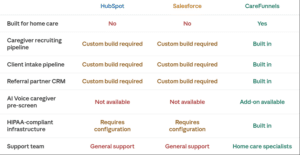
For agencies with the resources to support a large-scale CRM implementation, HubSpot or Salesforce can be made to work. It will cost more than advertised and take longer than expected, but it’s possible. For most home care agencies, the total investment rarely delivers a return that justifies the gap in functionality.
The Case for a Purpose-Built Home Care CRM
CareFunnels is the best home care software for private duty agencies looking for a CRM built from the ground up — not adapted from a B2B sales platform. Every pipeline, every automation, every contact type, and every integration was designed specifically around how homecare agencies actually grow. The platform gives caregivers and office staff the ability to track lead sources, view schedules, and access everything they need to thrive— from the office or from their mobile devices in the field.
Support comes from a team that understands the daily realities of home care operations. For growing home care businesses, that means less time managing software and more time focused on patient care, personal care service quality, and the referral relationships that drive sustainable growth.
The right CRM for home care agencies isn’t the most well-known option. It’s the one designed specifically for the home care industry — with the essential features your team will actually use on day one, and the flexibility to grow with your agency without a developer on speed dial.
Ready to see how CareFunnels compares for your agency? Schedule a free demo →