
Is Your Agency Invisible to AI Search?
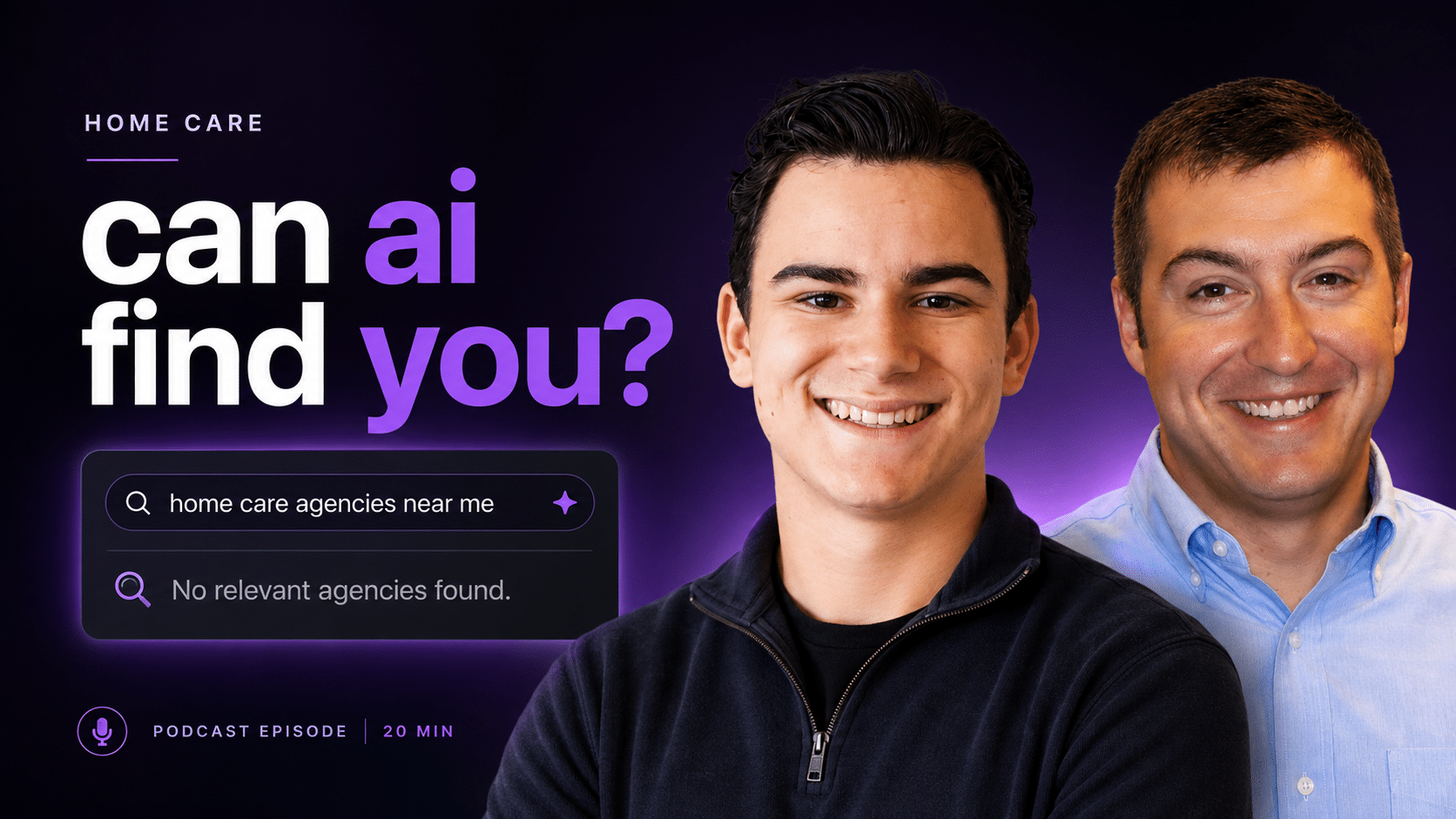
ChatGPT just crossed a billion monthly active users, and the way families search for home care is changing right along with it. In the very first episode of The Intake, the official Home Care Marketing Pros podcast, host Dylan Medina sits down with HCMP CEO and founder Jason Chagnon to tackle the question every agency owner is quietly worried about: if someone asks ChatGPT to recommend a home care agency, does it even know you exist? And if it does, is it saying something good?
What “Invisible to AI” Actually Means
For years, being found meant showing up in Google search. Now, Jason says, agencies have to think about showing up in ChatGPT, Perplexity, Claude — “you name the list.” Being invisible means a family asks AI for a recommendation and your agency simply never comes up, or worse, comes up in a way that doesn’t reflect well on you.
Key takeaway: The goal hasn’t changed — you still want to be the trusted answer when a family is searching for care. What’s changed is where that question is being asked.
The Fundamentals Haven’t Changed — AI Just Uses Them Differently
The most common misconception Jason hears from clients is that AI must be pulling from some mysterious new source. It isn’t. AI tools use the same foundational information marketers have always relied on:
- Your website
- Your Google Business Profile
- Your reviews
As Jason puts it, when someone asks ChatGPT to recommend a home care agency nearby, the AI does what a human would do — it searches, looks at the websites, checks the reviews, and makes a recommendation. Nothing about that process is a mystery; it’s just automated.
Is SEO Actually Dead?
Short answer: no. Jason pushes back on marketers who use “SEO is dead” as a scare tactic. SEO stands for search engine optimization — and ChatGPT, arguably, is a search engine too. People aren’t searching less; they’re searching differently. The fear-of-missing-out messaging (“if you’re not showing up in AI, nobody will ever find you”) is often just a new coat of paint on an old sales tactic.
Content Quality Over Content Quantity
AI makes it easier than ever to churn out huge volumes of content — but Jason is blunt about where that leads: “content stuffing.” Cranking out thousands of AI-written blog posts isn’t a strategy, because both search engines and readers can tell the difference between genuinely useful content and filler.
A well-written, locally relevant page is far more valuable to AI — and to real people — than generic “AI slop.” The bar isn’t did you publish something, it’s did you actually answer the question a family had.
Zero-Click Search: Why Website Traffic Isn’t the Whole Story
One of the more counterintuitive points in the episode: declining website traffic doesn’t necessarily mean declining performance. Jason explains zero-click search — when someone gets a full answer directly from Google or an AI tool, often citing your website as the source, without ever clicking through.
Key takeaway: The goal is no longer just getting people onto your website — it’s positioning your agency as the trusted, cited source in your community, whether or not that search results in a click.
Reviews: You Need More and Better Than the Competition
Asked how many (or how good) reviews an agency actually needs, Jason keeps it simple: more and better than whoever you’re competing with. In a market with a handful of options, a meaningful gap in review count or rating can be the deciding factor — the same way most people pick the pizza place with the most five-star reviews over the one with a single three-star review. Frequency matters too: a steady stream of recent reviews signals an active, trustworthy business, not one that peaked two years ago.
Authenticity Is Becoming a Ranking Advantage
As AI-generated content, video, and voice become more common, Jason notes that audiences are increasingly able to sense when something isn’t authentic — and they don’t like it. Real reviews from real clients and real feedback from the owner carry more weight than ever. For home care agencies specifically, that means the story of why you’re the better choice — not just that you are — needs to show up across your website and Google Business Profile.
How to Actually Measure Your AI Visibility
Measuring AI visibility for a local business is still genuinely hard, but Jason offers a few practical ways to gauge progress:
- Ask around. Have your team, friends, and family ask ChatGPT to recommend home care agencies in your area, and see who comes up.
- Watch referral traffic. Google Analytics can still show how much traffic is arriving via click-throughs from ChatGPT or Perplexity.
- Use call tracking numbers. A dedicated number on your website and a different one on your Google Business Profile lets you know exactly where a call originated. Jason notes it’s a small investment — around $1.15/month per number through CareFunnels, or available through services like CallRail.
Why AI Might Be a Genuine Win for Home Care
Traditional SEO leans heavily on keywords like “home care near me” — but that assumes the searcher already knows home care is the solution they need. After a decade in the industry, Jason still regularly has to explain that home care isn’t the same as assisted living. AI conversation changes that dynamic: someone can describe a situation (“I’m worried about my mother, she lives alone”) and have AI surface home care as an option they hadn’t considered yet — solving an awareness problem that keyword-based search never could.
Are Ads on ChatGPT Worth It Yet?
Not yet, according to Jason — at least not for most independent, local agencies. ChatGPT’s ad platform currently doesn’t offer the geographic and audience targeting precision local service businesses need, which means dollars can get wasted fast. National franchises may want to start experimenting now, but for agencies serving a handful of markets, it’s better to wait and watch this space evolve — which Jason expects to happen quickly.
Where Should a New or Budget-Conscious Agency Start?
If there’s one place to start, Jason doesn’t hesitate: Google Business Profile. It’s free, and fully optimizing it — not just claiming it — is the single most impactful thing an agency can do today. He recommends literally asking ChatGPT or Claude what it means to optimize a Google Business Profile for a home care agency, and following that guidance. After that, a solid website comes next.
Jason’s closing thought sums up the episode: the tools have changed, but the underlying job of marketing hasn’t — help people find you, and be genuinely the right choice when they do.
This episode is part of The Intake, the official Home Care Marketing Pros podcast. Subscribe to hear future episodes, and send us your topic ideas for what to cover next.
Get started with Home Care Marketing Pros.
Discover how Home Care Marketing Pros can help you grow your home care business, hire more caregivers and provide care for more clients.